

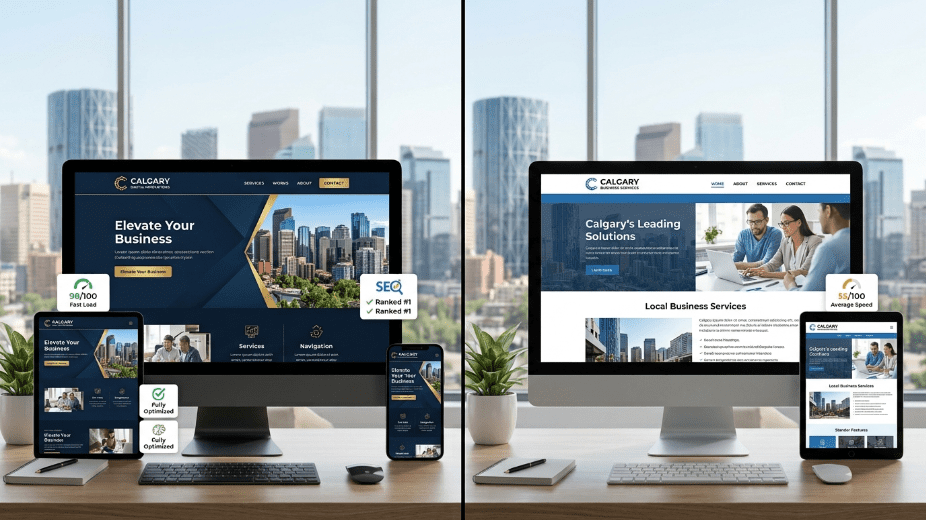
If you run a business in Calgary and you’re building or rebuilding your website, you’ve probably landed on two choices. You can go with a template, something quick and cheap from a builder like Wix or Squarespace, or you can invest in custom website design, where a team builds your site from the ground up around your business. Both get you online. Only one is actually built to grow with you. In this guide, we’ll walk through what separates the two, what Calgary business owners specifically need to think about, and how to figure out which route makes sense for where you are right now.
This isn’t a scare tactic article telling you templates are useless. They aren’t. But there’s a real difference in what each option can do for you long term, and that difference matters more once your business starts growing.
What Is a Template Website?
A template website is a pre-made layout you can buy or rent through a website builder. You pick a design from a library, drop in your logo, swap out some stock photos, add your own text, and you’re basically done. Platforms like Wix, Squarespace, and even a lot of “quick build” WordPress themes work this way.
There’s nothing wrong with this approach for certain situations. If you’re testing an idea, launching a side project, or you genuinely have almost no budget, a template can get you a working site in a weekend.
The catch is that thousands of other businesses are using the same template. Your site’s bones, the layout, the code, and the way pages load are shared with everyone else who picked that theme. You’re customizing the paint job, not the engine.
What Is Custom Website Design and Why It’s Different?
Custom website design means your website is planned and built specifically for your business. Nothing is copied from a shared library. A designer maps out how your customers actually move through a site, a developer writes the code around your specific goals, and every page is built to match how your business actually works, not how a generic template assumes it works.
This matters more than it sounds like on paper. Think about the difference between buying a suit off the rack and having one tailored. Both are suits. Both cover the same basic function. But one was made for a general body shape, and the other was made for you. Custom website design is the tailored version of your online presence.
For Calgary businesses specifically, this means your site can reflect your brand, your service area, your pricing model, and your customers’ actual questions, instead of forcing your business into a one-size-fits-all box that was probably designed for a completely different type of company in another country.
Custom Website Design vs Template Websites: A Side-by-Side Comparison
Here’s how the two options stack up across the things that actually matter to a business owner.
|
Factor |
Template Website |
Custom Website Design |
|
Upfront Cost |
Low, often a monthly subscription |
Higher initial investment |
|
Design Uniqueness |
Shared with other businesses |
Built only for your brand |
|
Loading Speed |
Often slower due to unused code |
Optimized, only what you need |
|
SEO Potential |
Limited by platform restrictions |
Built with an SEO structure from day one |
|
Scalability |
Hard to add advanced features later |
Grows with your business needs |
|
Mobile Experience |
Generic, sometimes clunky |
Designed and tested for your users |
|
Maintenance |
Platform handles basics, limited control |
Ongoing support tailored to your site |
|
Best For |
Startups, side projects, testing an idea |
Businesses planning for real growth |
Looking at this table, you can probably already guess where this article is heading. But the honest answer isn’t “always pick custom.” It’s “pick custom once you’re serious about growth, competing locally, and generating consistent leads.”
Why This Decision Matters More in Calgary Than You Might Think
Calgary is a competitive market. Whether you’re a plumber in the northeast, a law firm downtown, or a med spa in the southwest, your potential customers are almost always comparing you to two or three other businesses before they call. Most of that comparison happens on a phone screen, in under thirty seconds.
A properly built custom website design gives you a real shot at standing out in that split-second decision. It also tends to load faster on mobile, which matters a lot since most local searches in Calgary happen on phones. People are searching while commuting, comparing providers between appointments, or looking for a service they need right away. That’s one reason why businesses are investing more in mobile-first website design. If you’re interested in the impact mobile usability has on rankings and conversions, you can also read our guide on why every Calgary business needs a mobile-first website in 2026.
A properly built custom website design gives you a real shot at standing out in that split-second decision. It also tends to load faster on mobile, which matters a lot since most local searches in Calgary happen on phones, often while someone is driving, walking, or comparing options between appointments.
There’s also a local search angle. Google pays attention to how well a site is structured, how fast it loads, and how clearly it answers a searcher’s question. Template sites often carry extra code you don’t need, which can drag down performance. A custom build strips that out, which gives your site a cleaner foundation to actually rank for terms your customers are searching, like “plumber near me” or “Calgary accounting firm.”
Custom Website Design for Businesses in Calgary and Surrounding Areas
Many businesses serve customers beyond Calgary itself. Companies in Airdrie, Okotoks, Cochrane, Chestermere, and other nearby communities often face the same challenge: standing out in a competitive market while building trust online.
A custom website allows businesses to create location-specific content, showcase their service areas more effectively, and provide a better experience for local customers. This becomes especially important for service-based businesses that rely on local search visibility and lead generation.
Whether you operate in Calgary or surrounding Alberta communities, your website should be built around how your customers search, browse, and make buying decisions.
Pros and Cons of Each Option
Let’s break this down plainly, without picking sides just yet.
|
Pros |
Cons |
|
|
Template Website |
Cheap to start, fast to launch, easy for beginners to manage |
Generic look, limited SEO control, harder to scale, often slower |
|
Custom Website Design |
Unique branding, better SEO foundation, built to scale, faster performance |
Higher starting cost, longer build time, and requires a skilled team |
Neither list is wrong. A template genuinely can work fine for a business that just needs a basic online presence and doesn’t plan on relying on the website for leads. But if your website is meant to be a real sales tool, one that brings in calls, bookings, or online orders, the cons of a template start to outweigh the savings pretty quickly.
A Real World Example: What Custom Design Looks Like in Practice
It helps to look at an actual Calgary business rather than talk in theory. Take City Wide Courier, a local courier and delivery company operating across Calgary and Alberta. Their site is built around exactly what their customers need to do: understand the service area, see what types of deliveries are offered, and get in touch quickly for a pickup.
That’s the whole point of custom website design. It isn’t about flashy animations or trendy layouts for their own sake. It’s about structuring a site so a visitor with a specific problem, in this case needing something delivered fast, can find the answer and take action without digging through pages that don’t apply to them. A template builder simply isn’t set up to think through those kinds of business-specific decisions. A custom build is.
How Much Does Custom Website Design Cost in Calgary?
This is usually the first question business owners ask, and it’s a fair one. Pricing varies depending on how many pages you need, whether you need ecommerce functionality, and how much custom development goes into the backend.
Generally, you’ll see a few tiers in the Calgary market:
- Basic custom sites for small service businesses, usually five to ten pages, tend to run in the lower thousands.
- Standard business sites with more advanced features, integrations, and stronger SEO work sit in the mid range.
- Larger e-commerce or enterprise sites with complex functionality land at the higher end, since they involve more development time.
Compare that to a template subscription, which might cost you a monthly fee that feels small at first. Over a few years, though, many businesses end up spending close to the same amount on a template subscription that they would have spent on a proper custom build, except they end up with a generic site at the end of it instead of an owned asset built specifically for their brand.
It’s worth thinking about your website less like a monthly expense and more like a long-term investment. A well-built site should keep bringing in leads for years, not just look decent for a few months before it needs another overhaul.
SEO and Custom Website Design Go Hand in Hand
You can’t really talk about custom website design without talking about SEO, since the two are connected from the ground up. A site built from scratch lets a developer control every part of the code that affects how Google reads and ranks the page, from page speed to header structure to how images are labeled.
Template platforms often limit how much you can adjust under the hood. You might be able to add a meta description, but you usually can’t touch the deeper technical elements that actually move the needle for local search rankings. If ranking on Google’s first page matters to your business (and for most local businesses, it should), pairing a custom build with a proper search engine optimization strategy gives your site a real foundation to compete for the searches your customers are actually typing in.
Common Problems Businesses Face With Template Websites
Many businesses choose a template website because it seems faster and more affordable. The problem often appears later.
As a business grows, it may need custom service pages, advanced forms, CRM integrations, booking systems, or e-commerce functionality. Many templates struggle to support these requirements without adding multiple plugins or workarounds.
Another common issue is performance. Over time, template websites can become slower as additional features are added. This can affect user experience, search visibility, and conversion rates.
For businesses that depend on their website for lead generation, these limitations often become more expensive than investing in a custom website from the beginning.
Don’t Forget About Ongoing Maintenance
A website isn’t something you build once and forget about. Plugins need updates, security patches need to be applied, and content needs to be refreshed as your business changes. This is one area people underestimate when comparing template sites to custom builds.
Template platforms usually bundle basic maintenance into your subscription, which sounds convenient until you realize you have very little control over what’s actually happening behind the scenes. With a custom site, you typically work with a provider on a website maintenance plan that covers hosting, backups, security monitoring, and updates, giving you a clearer picture of what you’re paying for and why.
Either way, budget for ongoing upkeep. A site that never gets maintained, template or custom, will eventually slow down, break, or fall behind on security, and that hurts both your visitors’ experience and your search rankings.
How to Decide Which One Is Right for Your Business
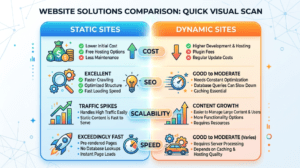
The choice usually comes down to your goals. If your website is simply a placeholder while you’re testing a new idea, a template website may be enough for now. But if you’re competing for customers, generating leads, and planning to grow, a custom website is often the better long-term investment.
Businesses in Calgary face strong competition, and standing out online isn’t always easy. If your current website feels outdated, slow, difficult to update, or no longer reflects your brand, it may be worth reviewing the common signs that your Calgary business website needs a redesign before deciding on your next step.
A custom website also gives you more flexibility as your business grows. Whether you’re adding new services, publishing content, or improving your online marketing, you’re not limited by the restrictions that often come with pre-built templates.
The goal isn’t simply to have a website. It’s to have a website that supports your business, attracts the right customers, and continues to perform well as your company evolves.
Why Calgary Businesses Choose to Work With a Local Team
Working with a Calgary-based team for your web design and development has a practical advantage that’s easy to overlook: they understand the local market. They know what Calgary customers respond to, what your competitors’ sites already look like, and how to structure a site around the specific industries common in this city, from trades and professional services to healthcare and hospitality.
A local team can also move faster when something needs updating, since you’re not stuck waiting on a support ticket queue for a platform based somewhere else entirely. That kind of responsiveness matters more than people expect once your website becomes a real part of how customers find and choose you.
Examples of Businesses That Benefit Most From Custom Website Design
Not every business needs a custom website on day one. However, custom website design tends to provide the greatest value for:
- Professional service providers such as lawyers, accountants, consultants, and financial advisors.
- Home service companies, including plumbers, electricians, HVAC contractors, and roofing companies.
- Healthcare businesses such as dentists, chiropractors, clinics, and medical spas.
- E-commerce businesses that require advanced product management and custom functionality.
- Growing businesses that plan to expand into additional locations or offer new services in the future.
For these types of businesses, the website is often one of the most important marketing assets they own. A custom website helps create a stronger brand presence while supporting long-term growth.
The Bottom Line
Template websites still have a place. They’re fast, cheap, and fine for a business that just needs something basic online. But once your business depends on your website to bring in customers, custom website design is the option built to actually support that goal. It gives you a site that looks like your brand, performs better in search results, loads faster, and can grow alongside your business instead of holding it back.
For most established or growing Calgary businesses, the decision usually comes down to this: templates get you online, but custom design gets you found, and it gets you chosen.