

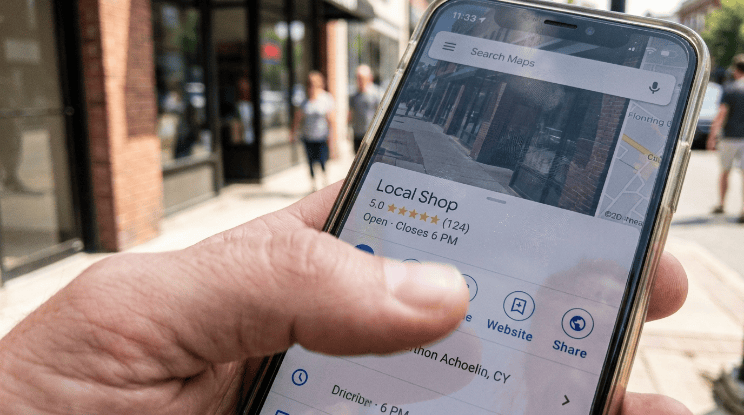
A customer searches for a plumber at 11pm. Three companies show up in the map pack. Two have 4.8 stars and dozens of recent reviews. One has 3.6 stars and hasn’t been reviewed since 2023.
You already know who gets the call.
That’s the entire story of Google reviews for local business in one scene. It’s not a nice-to-have anymore. It’s the first filter customers run before they ever dial your number, and it’s one of the clearest signals Google itself uses to decide who earns a spot in local search results.
At Clear Solutions IT, we manage review strategies for local businesses every week, and we’ve watched the bar rise fast. Here’s what’s actually happening in 2026, and what to do about it.
Why Google reviews for local business matter more than ever
Reviews used to be a side project. Something you asked for once, then forgot about.
That approach doesn’t work anymore.
The trust factor: what shoppers actually do before they buy

Nearly every consumer now reads reviews before choosing a local business. Recent industry survey data puts that number at 97%, and 71% of shoppers specifically check Google reviews as part of their research.
That’s not a small audience. That’s almost everyone who might become your customer.
And the bar keeps climbing. In 2026, 68% of consumers say they won’t consider a business rated below 4 stars. Nearly a third now hold out for 4.5 stars or higher, roughly double the share who set that bar just a year earlier.
Volume matters too. Close to half of shoppers will skip a business with fewer than 20 reviews, no matter how good the rating looks.
The 2026 shift: AI summaries and generative search
Something new is happening this year. A growing share of shoppers no longer read individual reviews at all. They read the AI-generated summary that Google, ChatGPT, or Gemini builds from those reviews instead.
That summary pulls from patterns across your reviews: recurring compliments, recurring complaints, common themes. A handful of vague five-star reviews with no detail gives the AI very little to work with. Detailed, specific reviews give it a lot.
This is the quiet reason review quality now matters as much as review quantity.
Google reviews and local SEO: how the algorithm actually reads them
Google has said publicly that reviews play a role in local ranking, alongside relevance and distance. It doesn’t publish an exact formula, but the pattern is consistent enough to plan around.
Google reviews ranking factor: what actually moves the needle
Four elements tend to carry the most weight:
- Star rating. Higher averages correlate with better map pack visibility.
- Review volume. More reviews signal an established, active business.
- Review velocity. A steady trickle of new reviews looks more natural (and more current) than a pile from three years ago.
- Review recency. Google and consumers both favor fresh feedback. Old reviews carry less weight every month that passes.
None of these work in isolation. A business with 200 reviews and a 3.2 average won’t outrank a business with 40 reviews and a 4.7 average in most local searches.
Star rating, review volume, velocity, and recency explained
Here’s a simple way to picture the four review signals side by side.
|
Signal |
What it tells Google |
What it tells customers |
|
Star rating |
Overall quality and satisfaction |
“Is this business good?” |
|
Review volume |
Business is established and active |
“Do enough people trust this place?” |
|
Review velocity |
Business is currently operating well |
“Is this still accurate today?” |
|
Review recency |
Content freshness for ranking |
“Does this reflect the business right now?” |
If you’re only tracking your star rating, you’re only watching one gauge on the dashboard.
The real benefits of Google reviews for small business
It’s easy to think of reviews as reputation management. They’re actually a growth channel.
More clicks, more calls
A strong review profile increases your click-through rate directly in search results and the map pack. Two businesses can rank next to each other, and the one with the better star display wins more clicks purely on visual trust.
Google Business Profile listings that are complete and well-reviewed also make consumers roughly 70% more likely to visit in person, according to recent local search research.
Free word-of-mouth marketing that never sleeps
A great review is word-of-mouth marketing that works at 2am on a Tuesday. It doesn’t get tiring. It doesn’t forget to mention you. It just sits there, doing its job, every time someone searches.
Compare that to the cost of a comparable amount of paid advertising and the math gets obvious fast.
How to get Google reviews for business (step by step)
Most businesses don’t have a review problem because customers hate them. They have a review problem because nobody asked.
Ask at the right moment
Timing matters more than script. Ask right after a positive interaction: right after a job finishes, right after a delivery, right after a support call ends well. Waiting a week drops your response rate hard.
Keep the task short. Something like: “Thanks for choosing us today. If you have 30 seconds, a Google review would mean a lot and help other customers find us.”
Use a review request link or QR code
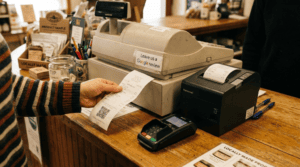
Friction kills review requests faster than anything else. If a customer has to search for your business, then find the review tab, then figure out how to leave a rating, most will give up halfway through.
A direct review request link removes almost all of that friction. Put it in:
- Follow-up emails and texts
- Receipts and invoices
- A QR code review sticker at the checkout counter or on service vehicles
- Your email signature
What not to do
Google’s fake reviews policy is strict, and it’s gotten stricter. Avoid:
- Paying for reviews or offering discounts in exchange for a specific rating
- Review gating (only asking happy customers to review, while quietly deflecting unhappy ones elsewhere)
- Posting reviews of your own business, or asking employees to
- Buying review packages from third-party sellers
Getting caught doesn’t just risk a few deleted reviews. Google can suspend your entire Business Profile, which erases your local visibility overnight.
How to respond to Google reviews (with examples)
Nearly 80% of consumers say they’re more likely to use a business that responds to reviews, positive and negative alike. Silence now reads as a red flag rather than neutral.
Responding to positive reviews
Keep it genuine and specific. Mention something from their review, thank them by name if they used one, and invite them back.
Example: “Thanks, Maria! Glad the team got your AC running before the weekend heat hit. See you at your next tune-up.”
Responding to negative reviews without losing your cool
This is where reputations are actually built or broken. Acknowledge the issue, avoid getting defensive, and move the conversation offline when it needs detail.
Example: “We’re sorry the appointment ran late, that’s on us. We’d like to make it right. Please call the office directly and ask for the manager.”
Response speed matters too. Nearly 1 in 5 consumers now expect a same-day reply, and most expect one within a week.
Google Business Profile reviews: optimizing the profile itself

Reviews don’t exist in a vacuum. They sit inside your Google Business Profile, and a weak profile undercuts even great reviews.
Make sure your profile has:
- Accurate business name, address, and phone number (matching your website exactly)
- Correct categories and service areas
- Regular photo uploads, not a stale set from three years ago
- Business hours kept current, including holiday hours
- Posts and updates published on a regular cadence
A complete profile with strong reviews reinforces each other. One without the other leaves visibility on the table.
Google reviews management: build a system, not a scramble
Chasing reviews one at a time is exhausting and it shows. A system beats a scramble.
|
Approach |
Pros |
Cons |
|
Manual requests |
Free, personal touch |
Inconsistent, easy to forget, slow to scale |
|
Review management software |
Automated requests, monitoring, reporting |
Monthly cost, setup time |
|
Hybrid (staff trained + light automation) |
Balances cost and consistency |
Needs ongoing staff buy-in |
Most small businesses land somewhere in the hybrid column: automated request texts triggered after a job or sale, paired with a manager who personally responds to every review within a day or two.
Local business reputation management beyond Google
Google is the biggest platform, but it’s not the only one anymore.
Other platforms that matter
Consumers now check an average of six different review sources before deciding, and platforms like Yelp, Facebook, and industry-specific sites (Angi, Healthgrades, TripAdvisor, depending on your field) still carry weight. Video platforms including YouTube and TikTok are also becoming informal review spaces, especially for younger shoppers.
Your reputation strategy should touch your top two or three platforms, not just Google.
Handling fake reviews policy issues
If you spot a review that’s clearly fake, from a competitor, an ex-employee, or a bot, flag it through Google’s official reporting tool rather than arguing in the comments. Keep records of why it’s fake (no record of the transaction, obvious spam pattern, and so on) in case you need to escalate.
Google star rating importance: how many stars is “good enough” in 2026
The honest answer: it depends on your industry, but the floor has moved up across the board.
|
Industry |
Approximate rating floor customers expect |
|
Restaurants |
4.4+ |
|
Medical and dental |
4.3+ |
|
Home services / tradespeople |
4.0+ |
|
Beauty and wellness |
4.5+ |
|
Retail |
4.0+ |
These numbers shift year to year, but the trend line has only gone one direction since 2023: up. A 3.8-star average that felt acceptable a few years ago now actively filters customers out before they ever see your website.
Common mistakes local businesses make with reviews
A few patterns show up again and again:
- Only asking for reviews after big jobs, ignoring the small, steady wins
- Responding to negative reviews defensively instead of calmly
- Letting review requests go out on autopilot with no personal touch
- Never mentioning specifics in review responses, which reads as generic to both humans and AI summaries
- Treating one bad month like a crisis instead of watching the trend
Fix the habits, and the numbers tend to fix themselves over a few months.
Final thoughts
Google reviews for local business aren’t a side task for slow afternoons. They’re one of the clearest signals customers and Google both use to decide who’s trustworthy enough to call.
The businesses winning local search in 2026 aren’t necessarily the biggest. They’re the ones that ask consistently, respond quickly, and keep their Google Business Profile current alongside a steady stream of fresh, specific reviews.
If your review strategy has been an afterthought, that’s an easy fix, and one of the highest-return changes you can make this quarter. Reach out to Clear Solutions IT for a free review and local SEO audit, and we’ll show you exactly where you stand against local competitors.