

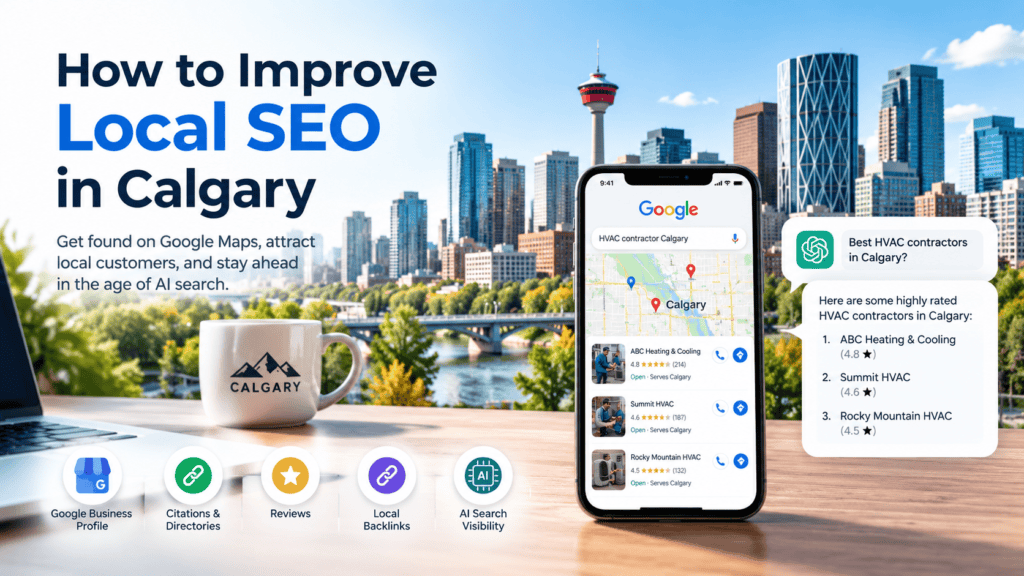
Quick answer: Here’s how to improve local SEO in Calgary: fix your Google Business Profile, keep your business listings (citations) consistent, earn real local backlinks, collect Google reviews the right way, and make sure AI tools like ChatGPT and Google’s AI Overviews can find and recommend you.
If you searched for this, you already know the basics: claim your listing, get reviews, add keywords. This guide is built for Calgary specifically, in 2026, without the filler.
Who Wrote This and Why It’s Different
We’re a Calgary-based digital marketing agency. Since 2011 we’ve managed Google Business Profiles and local search optimization for over 150 businesses across Calgary, Edmonton and Vancouver, many of them trades and home service companies: plumbers, electricians, HVAC contractors and roofers.
When we reviewed the guides currently ranking for this topic, we found three common gaps. Most skip neighbourhood-level advice, most stop at “claim your listing,” and almost none cover how people now ask ChatGPT and Google’s AI Overviews to recommend local businesses. This guide covers all three.
A Real Result
[Insert one concrete case study: client type (e.g., Calgary HVAC contractor), starting point, what you changed, result and timeframe. Example format: “After fixing categories, service areas and citations, calls from their Google Business Profile rose X% in Y months.”]
How to Improve Local SEO in Calgary: Why the City Is Different
Local SEO (local search engine optimization) is the practice of helping your business appear in Google Search and Google Maps when someone nearby searches for what you do: “same-day courier Calgary,” “flooring contractor near me,” “electrician Airdrie.”
Traditional SEO doesn’t care where the searcher is standing. Local SEO does. Google looks at their location, your Google Business Profile, and whether you appear to be a real, active business.
How Google Ranks Local Results: Relevance, Distance and Prominence
Google says local rankings depend mainly on three factors:
- Relevance: how well your profile and website match what the person searched for
- Distance: how close your business is to the searcher or the location named in the search
- Prominence: how well-known and trusted you are, based on reviews, links, citations and overall web presence
You can’t change distance, so most of this guide focuses on relevance and prominence.
Calgary Is a City of Neighbourhoods
The city is spread out, and people think locally. Someone in Kensington doesn’t think “I live in Calgary.” They think “I live in Kensington.” Your content should reflect that.
The Local 3-Pack Is the Battleground
Much of Calgary’s local economy runs on trades, couriers, cleaners and mechanics. For these businesses, the Local 3-Pack (also called the local pack or map pack: the three map listings above the regular results) is where most calls come from. If you’re not in it, your competitor probably is.
Step 1: Fix Your Google Business Profile Properly
Your Google Business Profile (GBP, formerly Google My Business) is the listing that appears in Google Maps and the Local 3-Pack. Every article says “claim your Google Business Profile.” That’s the easy 5% of the work. Here’s the rest.
Choose the Right Categories
Your primary category should match your core service exactly. A flooring contractor should choose “Flooring Contractor,” not “Home Improvement Service.” Add two or three secondary categories for specific services, such as “Hardwood Floor Installation.”
Set Your Service Area Correctly
If you cover Calgary plus Cochrane, Airdrie and Chestermere, name those areas directly instead of leaving the default radius. This influences which nearby searches you appear in.
Post Regular Updates
Google lets you publish short updates on your profile. A courier company might post holiday delivery hours. A contractor might share a photo from a job finished that week. Google hasn’t confirmed posts as a direct ranking factor, but they keep your profile current and give customers a reason to trust that you’re active. Once every week or two is a realistic pace.
Answer Your Own Q&A
Most owners never touch this section. Write down the five questions customers ask constantly (“Do you deliver to Airdrie?” “What’s your call-out fee?”) and answer them yourself before someone else guesses wrong.
Use Real Photos
Use job sites, your van with your logo, and your team at work. Skip stock images.
This setup is the first thing we audit for new Calgary clients, because it’s usually where the easiest gains are hiding. Google’s own Business Profile help documentation is worth a bookmark. If you’d rather hand it off, our local SEO services in Calgary cover it end to end.
Step 2: Keep Your Business Listings Consistent
A citation is any website that lists your business name, address and phone number (NAP): Yellow Pages, industry directories, local associations.
Why NAP Consistency Matters
If your website says “Unit 200, 123 5th Ave SW” and another directory says “123 5th Avenue SW, Suite 200,” that small mismatch can signal unreliable information to Google. Pick one format and use it everywhere.
Calgary-Specific Listings Worth Claiming
- The Calgary Chamber of Commerce business directory
- Your local Business Improvement Area, if you’re on a strip like 17th Ave, Kensington or Inglewood
- Alberta trade associations relevant to your field
How to Audit Your Citations
Whitespark’s free citation finder shows where your listings don’t match. No paid audit needed.
Step 3: Build Pages for Specific Calgary Neighbourhoods
Neighbourhood pages (local landing pages) are the biggest content gap in most guides on this topic.
Why Neighbourhood Pages Win
“Plumber Calgary” and “plumber Beltline” are different searches with very different competition. The second is usually easier to win, and few businesses write for it.
How to Build Them
If you serve more than one area, create a page for each one that matters: Beltline, Kensington, Airdrie, Cochrane, wherever your customers live. Each page should include:
- Something true and specific about the area
- The service described for that audience
- Proof you’ve worked there, such as a past job or a review from a local customer
- A link back to your main service page, so Google understands how the pages relate
When to Skip This
If you run a single-location business with one clear service area, you don’t need six near-identical pages with the city name swapped out.
Step 4: Earn Backlinks From Real Calgary Sources
A backlink is another website linking to yours. Google treats it as a vote of confidence and a signal of prominence, but only when it comes from a genuine source.
Quality Beats Quantity
Ten links from real Calgary sources beat a hundred bought links from random directories. Purchased link patterns can hurt you if Google’s systems flag them.
Three Realistic Link Sources
Local media: Outlets like Avenue Calgary or the Calgary Herald tend to link when you’re newsworthy or when you respond quickly to a reporter looking for a local expert.
Partner businesses: A flooring contractor and a real estate agent naturally refer customers to each other. A “who we recommend” page on both sites works when it’s written honestly.
Sponsorships: Local sports teams, charities and community events often include a link from an established domain.
What to Expect
Two to five solid local links per quarter is realistic for most small businesses. That’s slower than buying a package, but it holds up over time.
Step 5: Get Reviews the Right Way
Google reviews influence your local ranking, and they decide whether a stranger picks up the phone once they find you. Both the number of reviews and how consistently new ones arrive matter, along with your average rating.
Ask at the Right Moment
Ask right when the job finishes, while it’s fresh. A quick text with a direct review link converts far better than an email sent two days later.
Never Gate Your Reviews
Don’t route happy customers to Google and unhappy ones to a private form. This is called review gating. It violates Google’s policies and can get your profile penalized.
Reply to Every Review
Reply to all of them, especially negative ones. Something like “Sorry the delivery ran late on the 14th. We’ve since changed how we route that area” does more for your reputation than the original review did to damage it.
Step 6: Optimize for AI Search
AI search means AI-generated answers from Google’s AI Overviews, ChatGPT or Perplexity. People increasingly ask these tools things like “Who’s a reliable flooring contractor in Calgary?” instead of typing a traditional search. They favour clear, factual, consistent information over marketing language.
Write Answers the Way People Ask Questions
Put the direct answer in the first sentence, then add detail. For example: “Flooring installation in Calgary typically costs [your real range] per square foot, depending on material and room size.” Build a Q&A section on your key service pages using real customer questions.
Keep Your Business Facts Identical Everywhere
AI tools cross-check multiple sources to confirm that your business is a distinct, trustworthy entity. Your name, services, service area, hours and pricing range should match across your website, Google Business Profile and major directories. State them plainly on your site instead of burying them in copy.
Get Mentioned by Trusted Third Parties
AI tools lean on sources beyond your own site. Reviews, local news mentions, industry directories and association listings all help establish that you’re a real, reputable business in your category. This overlaps with your link-building and citation work.
Use Structured Data
Local business schema (covered in Step 8) gives machines a clean, unambiguous description of your business. Google now shows FAQ rich results only for a limited set of sites, so add FAQ markup for clarity, not for a guaranteed search feature.
Test Your Visibility
Once a month, ask ChatGPT, Perplexity and Google’s AI Overviews questions your customers might ask:
- “Best [your service] in Calgary”
- “Who does [your service] in [your neighbourhood]?”
- “How much does [your service] cost in Calgary?”
Record whether you’re mentioned, who is, and what sources they cite. Those cited sources show you where to earn mentions.
Step 7: Plan Around Calgary’s Seasons
Seasonal search demand is the predictable rise and fall in searches tied to weather and events. Calgary’s spikes are sharper than most, and most SEO advice ignores them.
Weather-Driven Demand
A Chinook followed by a sudden cold snap sends people searching for towing, furnace repair and snow removal at once. Stampede season brings a tourism surge across the city.
Prepare Before the Spike
If seasonality affects your business, prepare your content and Google Business Profile posts ahead of time. For example, publish furnace-repair and snow-removal pages and updates in early fall, before the first hard freeze, rather than after searches surge.
Step 8: Handle the Technical Side: Schema, Speed and Mobile
Technical SEO is invisible to customers but matters to Google.
Add Local Schema Markup
Local schema (LocalBusiness structured data) is a small block of code that tells Google what your business is and where it sits, in a format it reads directly. Schema.org’s LocalBusiness page lists the supported fields. A simple example:
{
  "@context": "https://schema.org",
  "@type": "LocalBusiness",
  "name": "Your Business Name",
  "url": "https://example.com",
  "telephone": "+1-403-555-0100",
  "priceRange": "$$",
  "address": {
    "@type": "PostalAddress",
    "streetAddress": "123 5th Ave SW",
    "addressLocality": "Calgary",
    "addressRegion": "AB",
    "postalCode": "T2P 0A1",
    "addressCountry": "CA"
  },
  "areaServed": ["Calgary", "Airdrie", "Cochrane", "Chestermere"],
  "sameAs": [
    "https://www.facebook.com/yourbusiness",
    "https://www.linkedin.com/company/yourbusiness"
  ]
}
Check Your Site Speed and Core Web Vitals
Test with Google’s free PageSpeed Insights, which reports your Core Web Vitals (loading speed, responsiveness and visual stability). Most local searches happen on a phone, and a slow site loses customers before they see what you offer.
Optimize for Mobile-First Indexing
Google mainly evaluates the mobile version of your site when ranking you. A clunky mobile experience can drag down rankings across the board. If your site is old or neglected, start here. Our website maintenance service in Calgary handles this for WordPress, Shopify and custom sites.
Step 9: Set Up Correctly If You Don’t Have a Storefront
A service area business (SAB) travels to customers rather than receiving them at a shop. Couriers, mobile mechanics and many contractors fit this model, and it’s fine not to have a public address.
Hide Your Address, Name Your Coverage
Hide your address in your Google Business Profile. List your actual coverage by name instead: Calgary, Airdrie, Cochrane, Chestermere, Okotoks, whatever is true for you. This determines which searches outside your home base you can appear in.
Step 10: Measure Whether It’s Working
Two free tools cover the essentials.
Google Business Profile Insights
Shows how people found you (Search vs. Maps) and how many called, requested directions or clicked through.
Google Search Console
Shows which search queries bring people to your site and whether your positions are improving.
How Often to Check
Review both monthly. If calls and direction requests from your profile are rising, it’s working, even if overall site traffic hasn’t caught up yet.
Your Calgary Local SEO Checklist
- Fix your GBP categories, service area and photos
- Post to your GBP every one to two weeks
- Answer your own Q&A on your profile
- Fix mismatched business info across directories
- Build neighbourhood pages if you serve more than one area
- Aim for two to five real local backlinks per quarter
- Send a text-based review request after every job
- Add local schema markup to your website
- Check Core Web Vitals and mobile experience
- Check GBP Insights and Search Console monthly
Want a Second Pair of Eyes?
You can do most of this yourself with an afternoon and the free tools above. If you’d like an expert to confirm what’s actually holding your rankings back, we offer a free local SEO audit for Calgary businesses, no obligation. Get your free audit here.
“These guys actually care. Whether it’s a quick update, a late-night issue, or just advice, they’re always there. It doesn’t feel like working with an agency.” Ahmed Q., Calgary client
About Clear Solutions Technology: Based in Calgary at Suite 200, 805 Manning Road NE, we’ve helped 150+ businesses across Alberta and Canada with web design, SEO, and digital marketing since 2011. Call us at 1-888-871-5557.
Local SEO is the process of optimizing your online presence so your business appears in Google Search and Google Maps when nearby customers look for your service. It matters in Calgary because most searches for trades, couriers and home services are local and mobile, and the businesses in the Local 3-Pack get the bulk of calls.
Focus on the three factors Google uses for local rankings: relevance, distance and prominence. Choose accurate GBP categories, name your service areas, keep your business details consistent across directories, and collect reviews steadily. You can’t change how close you are to the searcher, so relevance and prominence are where you can gain ground.
There is no magic number. Google doesn’t publish a threshold, and the right target depends on your competitors. Check the top three businesses in your category and neighbourhood, then aim to match or beat their review count and rating, while earning new reviews consistently rather than all at once.
No. Service area businesses like couriers, mobile mechanics and contractors can rank without a public storefront. Hide your address in your Google Business Profile and list the areas you actually cover, such as Calgary, Airdrie, Cochrane and Chestermere.
Publish clear, factual answers on your site, keep your name, services, service area and pricing identical across the web, and earn mentions from trusted third parties like local media, directories and review platforms. Then test monthly by asking AI tools the questions your customers ask and noting which sources they cite.
Only if you serve several areas and can say something genuinely different about each one. A page for Beltline or Kensington should include local proof, such as a past job or a customer review. If you run a single-location business with one service area, one strong page is better than several near-identical ones.